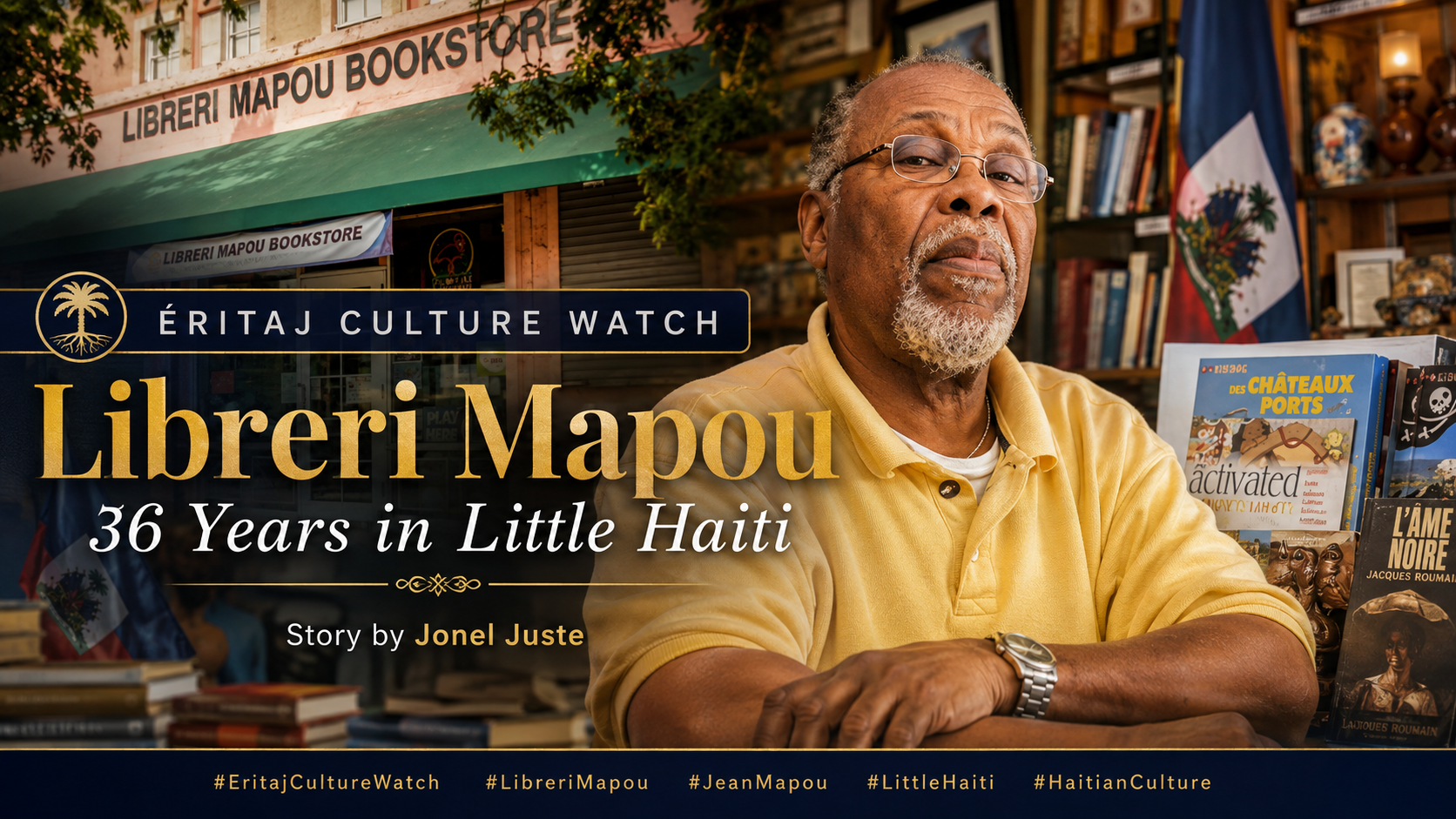
Journalist and Éritaj collaborator **Jonel Juste**, writing for *Le National*, recently revisited the remarkable story of Sant Kiltirèl Mapou and the vision of writer, playwright, activist, and cultural guardian Jan Mapou, Jean-Marie Willer Denis. The story begins in 1990, when Mapou was invited to present books at Miami’s Caribbean Marketplace. From that modest beginning grew a cultural institution that would become deeply woven into the life of Little Haiti. ([jonelblog][1])
Today, Libreri Mapou remains at 5919 NE Second Avenue, near the Little Haiti Cultural Complex. Its shelves hold books in Haitian Creole, French, and English on Haitian history, politics, literature, folklore, and Caribbean life. The center has also hosted conferences, book signings, presentations, community gatherings, theater rehearsals, and countless conversations that might otherwise have disappeared into the noise of migration. ([jonelblog][1])
The institution began with only a modest collection. Over time, educators and cultural figures such as Max Manigat and Anaïse Chavenet helped strengthen the library through book donations. Dany Laferrière became the first writer to hold a signing there, beginning a tradition in which writers and intellectuals left messages and signatures on the walls, turning the building itself into a kind of living manuscript. ([jonelblog][1])
Libreri Mapou has also long defended the Haitian Creole language. The very spelling of “Libreri Mapou” announces that commitment. Jan Mapou has repeatedly described the preservation of Haitian language and literature as central to the institution’s purpose, especially for generations growing up in diaspora. ([jonelblog][2])
Miami-Dade County recognizes Jan Mapou as a pillar of Haitian arts and culture. His wider work includes Sosyete Koukouy, cultural advocacy, literature, radio, theater, and decades of community service. In 2021, Miami-Dade County proclaimed May 15 “Jan Mapou Day,” honoring a lifetime devoted to keeping Haitian voices visible and alive. ([jonelblog][2])
Thirty-six years later, Libreri Mapou still asks a simple but urgent question: what happens to a people when the places that carry their memory disappear?
Books can be replaced. Buildings can be rebuilt. But cultural spaces accumulate voices. They remember who came through the door, who argued over a poem, who bought a first Creole book for a child, who heard a writer speak, who recognized Haïti on a shelf thousands of miles from home.
That is why Libreri Mapou matters.
It is not simply a bookstore in Little Haiti.
It is one of the places where Haiti continues to remember itself.
**Éritaj Culture Watch** salutes Jan Mapou and the generations of writers, readers, artists, educators, and community members who have kept this institution alive for thirty-six years.
**Source and reporting:** Jonel Juste for *Le National*
**Additional context:** Miami-Dade County Department of Cultural Affairs, WLRN, and previous reporting on Libreri Mapou.
**Éritaj Culture Watch**
Culture. Memory. Transmission.
**Radio 1804, Éritaj FM**
[1]: https://joneljuste.com/2026/09/02/sant-kiltirel-mapou-36-zan-sevis-nan-kominote-ayisyen-nan-mayami/?utm_source=chatgpt.com "Sant Kiltirèl Mapou: 36 zan Sèvis nan Kominote Ayisyen nan Mayami – jonelblog"
[2]: https://joneljuste.com/2021/06/22/libreri-mapou-reopens-in-little-haiti/?utm_source=chatgpt.com "Libreri Mapou Reopens in Little Haiti – jonelblog"
Jonel Juste For : EritajFm | Radio 1804 A Division of the InterfineArt Group, LLC